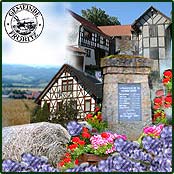
- Fröbitz
Place of the Froebels
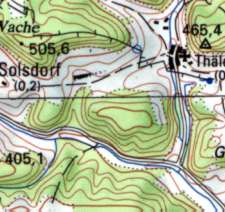
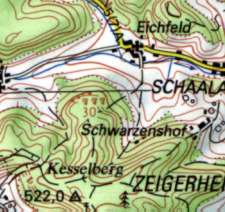
This former Adelsdorf or noble manor was first mentioned in written records in 1375 as Frowitz. Reynhart von Holbach zcu Vrowicz reached an agreement about the boundaries of vineyards between the common fields and the hill with the Paulinzella monastery and the burgers of Blankenburg in 1395. Alternative spellings include Vröwitz and Frobitz. Herbs, vegetables, flowers and fruit were grown on these manors based on Capitulare de Villis issued by Charlemagne.
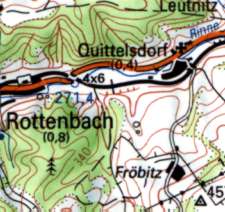
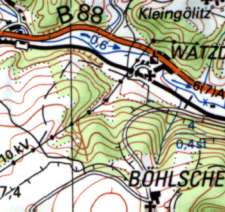
During the fourteenth century there was silver mining at Böhlscheiben and Watzdorf and grapes were grown from Quittelsdorf to Böhlscheiben between Fröbitz and the river. There was also a brewery at Watzdorf in 1411. After the dissolution of the monastries in 1534, Paulinzella passed to the Counts of Schwarzburg. Schwarzburg-Rudolstadt became a Principality in 1700 and continued as a sovereign state until 1920, when it formed part of the new state of Thuringia.
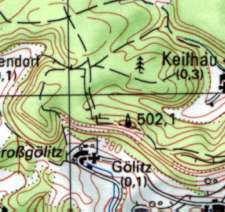
The ancestry of Friedrich Froebel, the inventor of Kindergarten, has been traced to Caspar Froebel, who died in 1640 at Großgölitz. Friedrich Froebel wrote in 1826 that Schwarzburg and Thuringia were his home and his native land. Lavendar grows today on the hillsides where grapes grew in the Middle Ages.
 |  |  |
 |  |  |
origin of place name - Fröbitz
It has been suggested that the name of this manor may be derived from vrobica an ancient word, which means logging and therefore refers to the clearing of the forest to provide wood for the silver mines at Böhlscheiben and Watzdorf. Another possibility is that the name means the clan of Frowin and refers to a lord of the manor, who was Frodewin or Freawine. It has also been noted that Frowen is an older form of Frauen and may refer to a wayside shrine on a path through the forest.
origin of family name - Fröbel
Claus Frowein is mentioned in 1506 in a document from Paulinzella, which is written in German. The family name Frobenius appears at that time in documents written in Latin. Later the family name is written as Fröbel for Lutheran pastors in various places such as Pirna, Neuenrode and Webau. This form reflects the style of written German developed in the Saxon chancery and adopted by Martin Luther for the translation of the Bible.
development of the umlaut
The letter "e" was written as a superscript to indicate a long vowel sound typical of plural forms. In the forms of handwriting, which emerged in the early modern period, the letter had two strong vertical lines, and the superscript looked like two tiny strokes. Gradually these strokes were reduced to dots, and this handwritten convention was transferred to printed texts.

site map - info@friedrichfroebel.com
Copyright © 2002-10 friedrichfroebel.com. All rights reserved.